Wednesday, 11 March 2015

Tuesday, 10 March 2015
Evaluation Question 7
7. From our preliminary task, which featured me losing my phone under a set of stairs and molly helping me finding it, was used as a mock production before our opening thriller sequence, a chance for us not only to work on our acting skills, but also get familiar with using the camera and tripod and explore it's uses, and also practise possible camera shots in situations that we could implement into our main production. From our preliminary task to our main production, I myself learnt a number of things. Based on watching the preliminary task back and looking at our main production, the first thing I noticed was the use of camera angles were far better in the main production compared to the preliminary task, for example, throughout the preliminary task, it only really appeared that we used mid-level and medium shots, showing a lack of diversity, however this changed in our main production drastically, using a wide range of camera shots, such as high angle, panning and P.O.V. This showed that not only myself, but my group members had gained a better understanding of camera use and the effects it can have during this time and I was able to make suggestionsn when creating our group storyboard and designing our frames. It seemed only one camera angle, a medium shot was used during the preliminary task, which greatly changed in comparison to our main production. Our main production obviously turnt out much better than our preliminary task, and I had learnt different things in general about things such as sound technique and mis-en-scene in general and how it can be used to draw in an audience and set the tone for the audience in a scene, by then my skills and knowledge had improved, as did my group members, which played a part in our production being successful. A difficulty we had of the preliminary task was that we did not know much about filming and appropriate camera shots to suit situations, but we overcame this with experimenting, and looking back at our filming on the camera at the time to decide whether or not we were satisfied with the shots, which lead to us finally settling on which shots we were happy with, and our knowledge of camera use and editing greatly improved through making our production, as we spent more and more time with the cameras to gain more experience and knowledge to help us complete our productions. If I had to do anything differently from my preliminary task, I would improve my acting, because if it was better and I could've impressed then, maybe I could've been the main character, Cameron in my production, and in my next media coursework filming assignment, I hope to take a main role and further showcast the potential of my acting skills.


Me and Molly acting in a shot
A close-up of me acting in the scene
Experimenting different shots (Long shots)
Monday, 2 March 2015
Evaluation Question 2
2. Our media product featured a male antagonist, and two female victims, which is very conventional to a thriller, as this is one of the main features and what you would commonly expect to see in a thriller, for example, it is present in Alfred Hitcock's best-seller "psycho". This is conventional and common as females are usually seen as easier to overpower, which makes the audience more fearful and draws them in more if they see a female being attacked instead of a male, as it builds further suspense as their feelings of fear are stronger. As many people are used to seeing this, we did not try to change a typical and standard convention, as although we wanted to be a little bit different, we did not want to take too many risks in doing so incase our audience did not like our production.In our production, the male is displayed as powerful, unpredictable and dangerous, like many other thrillers, an example being hannibal lector from silence of the lambs, who displays all of these characteristics, however we also tried to display cameron slightly differently in a less-stereotypical and a more subersive fashion, as he had a bad childhood, showing he is depressed and emotionless, but it is not his fault, meaning that the audience show sympathy for the antagonist, which is rare for a thriller and I believe a good twist yo our production, as it also draws the audience as they have many emotions and feelings towards the antagonist. The females in our production are displayed as worried and innocent, like many in most succesful thriller films, meaning it is stereotypical, as it is a main convention of the genre and we used it in our production seeing as it had been so well known and successful in the film industry. Although we wanted to be different, we did not change the stereotype of women in thriller films, as although subersive plots such as the plot in silence of the lambs where the main protagonist is an aggressive dominant female has worked before, audience are used to seeing women as vulnerable, powerless and endangered, and in the past this has been the most common formula to grip and attract an audience. The characters appeal to the audience in a number of ways, Cameron's girlfriend is a typical, outgoing and innocent teenage girl, which many females aged 14-19 who view our production can relate to. Our main antagonist, Cameron is an emotionally confused and depressed character, which may be hard many member in our audience to relate to, however the audience feel sympathy for him, as the problems as has been through are not his fault and it's almost as if he cannot help it, bringing out strong feelings from the audience towards him.


Shot of Cameron stalking his Girlfriend
Cameron killing his mother
Wednesday, 18 February 2015
Evaluation Question 1
1. My product; Disutrbia managed to use, develop and also challenge real life thriller media products in a number of ways. In a thriller film, it is usually expected that there is a main antagonist and protagonist, with the story usually being the two battling each other, with suspense and tension created leading up to this, followed by surprise and shock. Your typical thriller may feature the following conventions, such as a powerful dominant male being the main antagonist and a vulnerable female being the main victim, usually seen with blonde hair, films such as the shining and psycho are both examples of vulnerable female victims being hunted by a powerful male antagonist. Suspense, shock, tension and surprise are the four main elements of a thriller, which are usually built by micro-elements, such as mis-en-scene, sound, lighting and cinematography. My film builds tension in a number of ways, especially during the kitchen scene, where iconography and slow editing is used to build suspense, where Cameron grinding the knife gets slower and slower, coming to a sudden point where he slams it into the plate, the audience are taken away by this, which further draw them into the scene, which then leads into the shock where Cameron kills his own mother. My film also followed the generic conventions of a thriller in a number of ways, having a dominant and unpredictable male antagonist have weak and vulnerable female victims, as Cameron kills his mother and the ending features a cliffhanger where his girlfriend is in danger. This can be compared to a thriller such as the shining, where the main character, Johnny is hunting an innocent, weak and vulnerable female, which is his wife. Although our character is not as insane, he too like Johnny is mentally unstable and the added sense of unpredictability creates suspense and keeps the audience on edge, wondering what will happen next.


Tension:
Shock:
Surprise:
Eery Music
Suspense
Slow editing
Friday, 6 February 2015
Final Group Thriller- Miss Georgiou
West Htach High School-16807
Jake Butler- 9313
I also worked with Molly and Claire
Molly Emmerson- 9327
Claire Golightly- 9334
Jake Butler- 9313
I also worked with Molly and Claire
Molly Emmerson- 9327
Claire Golightly- 9334
Sunday, 4 January 2015
Rough Cut
https://www.youtube.com/watch?v=0NWTiw5BU7A
Audience feedback is important to any group/director about their sequence for a number of reasons. It allows the directors of the sequence to see peoples real opinions of the production, it is useful for knowing what went well, what the audience didn't like about it, and also what to change for next time if you were to make a sequel or second production. Feedback from various members of the audience allows you to gather an insight of what people thought in general about your production.
We recieved various feedback from our potential/actual audiences before and after the film in a number of ways, using questionnaires, vox pops, and also actual youtube comment reviews about our thriller sequence. The questionnaires towards our intended target audience allowed us to see what they prefer in a thriller film, such as weapon used, villains identity and sub-genre of thriller e.g crime, psychological. Our vox pops were used to show visual evidence of this and real-life interviews, which were also posted to youtube. After hearing and taking the comments into account, we then set about making our own thriller sequences in groups, looking to make them as effective as possible and also appeal to the needs of our target audiences after hearing their opinions.
Here we have four youtube comments that are reviews from people who watched our sequence, and these comments were left under the post of our uploaded thriller production.
Looking at the top comment from Kerry Boyne, we can see that she was generally pleased with what she saw and liked our production, giving us credit for our narrative, which in her opinion made the sequence "interesting and engaging" which meant we succesfully were able to draw her into the plot and the sequence itself. Another positive to take from this comment that our low-key lighting used throughout was pretty effective as it built tension. Kerry believed that we could have maybe left the titles up longer so that they were easier to read and that also a darker filter should've been used during the suicide scene to further set the tone. I believe overall this was a very positive comment, Kerry clearly enjoyed our sequence, and if out of two constructive comments she could only find the timing of titles to be a bad point, then our sequence was effective at drawing her into the plot and at the same time entertaining her.
From Amy's comment, we noticed that she pointed out slightly different positives about our sequence compared to Kerry, instead praising our use of Cinematography and camera angles, as well as the acting in the scenes. She thought we could use more sound at the final point of the sequence to build more tension and suspense. This could also add shock to audience, as they would not expect it, which is a good point to take from Amy as she could be right and maybe this would've made the ending more effective, however adding suspenseful and shocking sound to a character appearing from no where would almost pretty much be a jump scare, which is very typical and common in the thriller genre and we have stated from the start that we didn't want to be so one dimensional and sterotypical and also seperate ourselves to have our own style, plus it was revealed in our questionnaire that most people nowadays would actually prefer if a thriller film did not contain jump scares.
From Malu's comment, we can gather that like Kerry, she also liked our narrative, which means it was clearly effective if others were agreeing with this statement, however Malu also shared constructive comments with Kerry and Amy about the sounds behind used when morgan is in the frame, which shows this was a clear negative in our sequence, as it was a common constructive comment and that we could have clearly done better to make the end of our sequence more effective.
From Bettie's comment, we can see again our audience liked our transition of shots and use of them, but also another common negative as she also felt our credits did not appear long enough, but it is evident that she enjoyed our sequence as this was the only negative that she could point out, meaning overall, apart from the sound used when Cameron appears in shots, our thriller sequence was effective, the audience were drawn in and engaged into our narrative, and we displayed our scenes and shots well with good camera shots.
In conclusion, the audience in general liked our narrative, and were very impressed with our shots, meaning Claire did a very good job in her role as filming the scenes. We could however have done better towards the end of the sequence to build even more of an atmosphere and create shock and more tension for the audience, but overall we were clearly effective in doing this otherwise, and our sequence recieved generally positive reviews and it's clear to see our audience were staisfied.
 .
.
Audience feedback is important to any group/director about their sequence for a number of reasons. It allows the directors of the sequence to see peoples real opinions of the production, it is useful for knowing what went well, what the audience didn't like about it, and also what to change for next time if you were to make a sequel or second production. Feedback from various members of the audience allows you to gather an insight of what people thought in general about your production.
We recieved various feedback from our potential/actual audiences before and after the film in a number of ways, using questionnaires, vox pops, and also actual youtube comment reviews about our thriller sequence. The questionnaires towards our intended target audience allowed us to see what they prefer in a thriller film, such as weapon used, villains identity and sub-genre of thriller e.g crime, psychological. Our vox pops were used to show visual evidence of this and real-life interviews, which were also posted to youtube. After hearing and taking the comments into account, we then set about making our own thriller sequences in groups, looking to make them as effective as possible and also appeal to the needs of our target audiences after hearing their opinions.
Here we have four youtube comments that are reviews from people who watched our sequence, and these comments were left under the post of our uploaded thriller production.
Looking at the top comment from Kerry Boyne, we can see that she was generally pleased with what she saw and liked our production, giving us credit for our narrative, which in her opinion made the sequence "interesting and engaging" which meant we succesfully were able to draw her into the plot and the sequence itself. Another positive to take from this comment that our low-key lighting used throughout was pretty effective as it built tension. Kerry believed that we could have maybe left the titles up longer so that they were easier to read and that also a darker filter should've been used during the suicide scene to further set the tone. I believe overall this was a very positive comment, Kerry clearly enjoyed our sequence, and if out of two constructive comments she could only find the timing of titles to be a bad point, then our sequence was effective at drawing her into the plot and at the same time entertaining her.
From Amy's comment, we noticed that she pointed out slightly different positives about our sequence compared to Kerry, instead praising our use of Cinematography and camera angles, as well as the acting in the scenes. She thought we could use more sound at the final point of the sequence to build more tension and suspense. This could also add shock to audience, as they would not expect it, which is a good point to take from Amy as she could be right and maybe this would've made the ending more effective, however adding suspenseful and shocking sound to a character appearing from no where would almost pretty much be a jump scare, which is very typical and common in the thriller genre and we have stated from the start that we didn't want to be so one dimensional and sterotypical and also seperate ourselves to have our own style, plus it was revealed in our questionnaire that most people nowadays would actually prefer if a thriller film did not contain jump scares.
From Malu's comment, we can gather that like Kerry, she also liked our narrative, which means it was clearly effective if others were agreeing with this statement, however Malu also shared constructive comments with Kerry and Amy about the sounds behind used when morgan is in the frame, which shows this was a clear negative in our sequence, as it was a common constructive comment and that we could have clearly done better to make the end of our sequence more effective.
From Bettie's comment, we can see again our audience liked our transition of shots and use of them, but also another common negative as she also felt our credits did not appear long enough, but it is evident that she enjoyed our sequence as this was the only negative that she could point out, meaning overall, apart from the sound used when Cameron appears in shots, our thriller sequence was effective, the audience were drawn in and engaged into our narrative, and we displayed our scenes and shots well with good camera shots.
In conclusion, the audience in general liked our narrative, and were very impressed with our shots, meaning Claire did a very good job in her role as filming the scenes. We could however have done better towards the end of the sequence to build even more of an atmosphere and create shock and more tension for the audience, but overall we were clearly effective in doing this otherwise, and our sequence recieved generally positive reviews and it's clear to see our audience were staisfied.
.Wednesday, 3 December 2014
Production Roles - Miss Miller
Production Roles
When creating a film, many roles are included as well as actors that take place behind the scenes. All people involved in the film are assigned their own role and credited in the film. It is essential to have directors, actors, producers and people behind the scene to contribute towards the film.
In our group, the following roles are as follows
Producers- Go Butson
Director - Molly, Claire
Actors - Morgan, Jake, Molly, Grace
Director of photography- Claire
Music producers- All
Screenplay writer- Jake
MES co-ordinator- Jake
Editors- Molly
We all played a part in producing and worked together as a group to create things such as the storyboards and posts, molly and claire were the directors as they previously filmed a production at GCSE, whilst I opted to create a magazine instead.
Morgan is the main character and antagonist and while my group had to re-film I had to cover for him, molly features as his girlfriend while grace plays the mother. Claire was made director of photography as she previously took this as a GCSE subject. We all helped in chosing and producing the music relevant to the scene as we used molly's computer to open editing to edit and compare the sounds. I was made screenplay writer as I was able to showcast my talents in this as I take A-level english langauge and achieved an A in GCSE. I was made MES co-ordinator for my previous work in media studies at GCSE. Molly is the main editor as the film and memory card is on her computer.
From working with claire, mainly in molly's absense, we were able to make very effective editing with sound and also some shots in the sequence. We agreed on most ideas together and it was fun working with her as we got a lot done when on a task alone together, and hopefully I can continue working with her more in the future.
I believe Molly voiced her opinion well with most topics and took a good stand on things, especially improvements to make and the overall editing and also she performed well in her acting role, however I tried to involve myself as best as I could within the group and felt I was often shut out, and from the beginning they did not need me to act nor change the plot, and although I enjoyed my roles as MES Co-ordinator, screenplay writer and sound editor, I wished she would've let me take part in more things in the group, that I hope will happen during the next group task we are given.
Overall I believe everyone contributed well in their role, they were chosen well and all for a reason, which is why everything has worked out effectively so far in our group and I enjoyed participating in the roles that I was given. I don't believe anything could've been done differently as everything has been effective and has played out well.
When creating a film, many roles are included as well as actors that take place behind the scenes. All people involved in the film are assigned their own role and credited in the film. It is essential to have directors, actors, producers and people behind the scene to contribute towards the film.
In our group, the following roles are as follows
Producers- Go Butson
Director - Molly, Claire
Actors - Morgan, Jake, Molly, Grace
Director of photography- Claire
Music producers- All
Screenplay writer- Jake
MES co-ordinator- Jake
Editors- Molly
We all played a part in producing and worked together as a group to create things such as the storyboards and posts, molly and claire were the directors as they previously filmed a production at GCSE, whilst I opted to create a magazine instead.
Morgan is the main character and antagonist and while my group had to re-film I had to cover for him, molly features as his girlfriend while grace plays the mother. Claire was made director of photography as she previously took this as a GCSE subject. We all helped in chosing and producing the music relevant to the scene as we used molly's computer to open editing to edit and compare the sounds. I was made screenplay writer as I was able to showcast my talents in this as I take A-level english langauge and achieved an A in GCSE. I was made MES co-ordinator for my previous work in media studies at GCSE. Molly is the main editor as the film and memory card is on her computer.
From working with claire, mainly in molly's absense, we were able to make very effective editing with sound and also some shots in the sequence. We agreed on most ideas together and it was fun working with her as we got a lot done when on a task alone together, and hopefully I can continue working with her more in the future.
I believe Molly voiced her opinion well with most topics and took a good stand on things, especially improvements to make and the overall editing and also she performed well in her acting role, however I tried to involve myself as best as I could within the group and felt I was often shut out, and from the beginning they did not need me to act nor change the plot, and although I enjoyed my roles as MES Co-ordinator, screenplay writer and sound editor, I wished she would've let me take part in more things in the group, that I hope will happen during the next group task we are given.
Overall I believe everyone contributed well in their role, they were chosen well and all for a reason, which is why everything has worked out effectively so far in our group and I enjoyed participating in the roles that I was given. I don't believe anything could've been done differently as everything has been effective and has played out well.
Monday, 1 December 2014
Opening Sequence Narrative
Opening Scene Narrative
Introduction
The first frame of our opening sequence is of a longshot of the main character and antagonist, Cameron, shot in the school corridor, dragging a chair along the hallway creating an eery sound, and preparing for his own suicide. The sound used here is very basic in this scene, as the focus is mainly on the squeaking sound of the chair, which is an eery and adds suspense, keeping the audience on edge and unsettled. The scene continues and goes onto a medium shot and the sound and frame remain similar, now focusing on just building up the tension in the scene. This scene then shows Cameron opening the door which follows the scene with the stair case. This shot here is another medium one and all the audience can hear now is the door creaking slowly behind him, which then this changes into a close up of the door, which then shuts firmly and suddenly to show how trapped Cameron actually is. The scene then fades to black, by using low key lighting to set the mood and is reunited with a close up of him tying the rope around the metal staircase.
The next shot is filmed in the same location, which is still shown as damp and dusty to the audience. The use of iconography is now present in this frame as the chair and scarf are now seen, which is used as a suicide rope for Cameron. As the main character Cameron steps onto the chair, eery sounds can be heard non-digetetically as they are not on seen on the screen. A close up of Cameron's lifeless and emotionless face is then shown to the camera and also the audience. We used makeup under his eyes to show his exhaustion. His facial expressions continue to appear as if he has given up, now on life itself as suspense and tension is created as it is clear his intentions are suicide.
The cinematography in this scene changes as it zooms out into a medium shot. The editing is very slow in this part, as we planned to use slow motion to prolong his death and drag out the scene, creating tension and suspense. The final frame in this scene is filmed with a medium shot. The audience can see his legs continuously struggling. The iconography remains the same and all the audience see now is the chair being kicked over by him. The soundtrack remains dark and depressing to create the effect and realisation that his life has come to an end. The positioning of the character Cameron remains very unsettled as we see his struggle after killing himself. The editing then comes in from a big fade/flash transition to show we have actually gone back in time to where Camerons struggles began.
The cinematography in this scene changes as it zooms out into a medium shot. The editing is very slow in this part, as we planned to use slow motion to prolong his death and drag out the scene, creating tension and suspense. The final frame in this scene is filmed with a medium shot. The audience can see his legs continuously struggling. The iconography remains the same and all the audience see now is the chair being kicked over by him. The soundtrack remains dark and depressing to create the effect and realisation that his life has come to an end. The positioning of the character Cameron remains very unsettled as we see his struggle after killing himself. The editing then comes in from a big fade/flash transition to show we have actually gone back in time to where Camerons struggles began.
The first frame in the next scene could suggest that Cameron had a 'normal' family life growing up. The sound of eating is present and digetic and the long shot is used to show the positioning of the characters which is Mother and Son placed awkwardly at different ends of the table, creating suspense. The iconography in this scene is the cutlery and food that is left out for the pair of them to eat. The constant sound of eating and knives against the plate is can be heard and the lighting remains quite natural considering this is shot during the evening. The shot that follows is a P.O.V shot form Cameron's eyes as he is looking at his mother as she begins to nag him, talking about a doctors appointment.
Her facial expression remains concerned and the only digetic sound we hear is the mother raising her voice about how she believes Cameron has behaved.
A close up is then shot of Cameron stabbing his knife into the his toast here. The audience see the anger in the way he uses this iconography which builds up the audiences perspective of what type of character Cameron is. We then see Cameron's whole body language after this, his position stays very stiff and his facial expression remains very tense. The lighting then becomes darker as the scenes atmosphere fades away. The sound of his mothers dialogue and speech is faded as Cameron's intentions and thoughts turns dark. The next shot shows an extreme close up of Cameron's dark eyes. Eery sounds begin then appear as we see the frustration in his facial expression. A sudden fade then comes in which lasts roughly 3 seconds. Cameron then shuts his eyes.
The final scene is then played out, with a medium shot that shows Harmony, his girlfriend walking. The audience are then able to see an empty looking street and a bush to the right. The following shot remains quite low and only shows half of her body. Her phone then begins to ring and a medium shot is used so the audience can see her answering the phone.
When the phone remains fuzzy and threatening she panics and a P.O.V shot is shown as she frantically looks around to see if anyone is watching her. Cameron replies with 'Cameron's Not Here Anymore' - As Harmony walks off we see her in a black coat. She wears all black to connotate that danger is near for her. We got Cameron to remain in a suit almost to show the contrast in characters. When he is innocent he wears white. When he is in black he is evil and the fact he is in a suit at the end shows that this is only the beginning for Cameron. His 'protagonist side' wants to trick the audience into thinking his in charge.
When the phone remains fuzzy and threatening she panics and a P.O.V shot is shown as she frantically looks around to see if anyone is watching her. Cameron replies with 'Cameron's Not Here Anymore' - As Harmony walks off we see her in a black coat. She wears all black to connotate that danger is near for her. We got Cameron to remain in a suit almost to show the contrast in characters. When he is innocent he wears white. When he is in black he is evil and the fact he is in a suit at the end shows that this is only the beginning for Cameron. His 'protagonist side' wants to trick the audience into thinking his in charge.
If this was an entire film the storyline would continue to show how Cameron's innocent side deals with the guilt which leads him to his suicide and how does the film actually end does Cameron really die. The fact that Cameron appears to kill himself at the start how does this differ to sterotypical thrillers.
Risk Assesment

It is important to consider risks before filming, as we do not want anyone getting injured during our production and also make sure it is completely safe to film in order to ensure there is no distractions and we are wary of hazards so everything can run smoothly. If a group member or actor is hurt from a hazard, not only may they not only be able to take part in the production, serious injury or even death may occur, which is very bad for obvious reasons.
The risk assessment will assist us with filming as it will make sure we are in a safe environment and remove all possible dangers that we may encounter before filming. It also ensures no one is hurt and that we have covered all possible dangers we may encounter when filming, meaning that our group members and actors will be perfectly safe and aware of all hazards.
Friday, 28 November 2014
Filming Schedule- Miss Georgiou

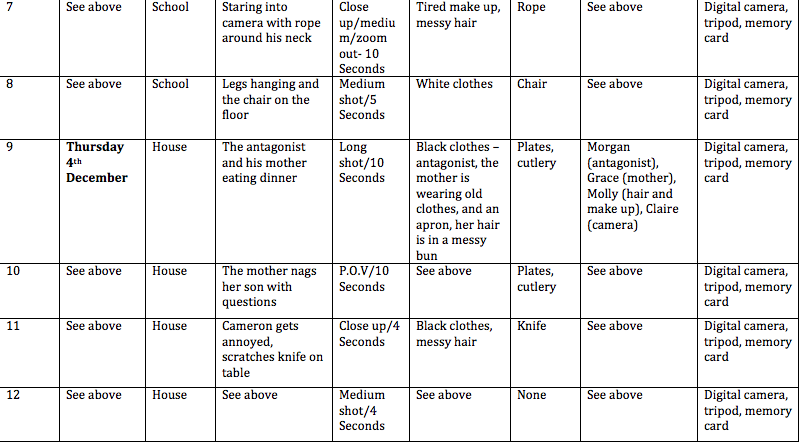


A filming schedule is important to have, as it keeps everything organised in your group to do with your filming, such as when and where we will meet too film and also what we will need in each scene. Withput a filming schedule, scene filming would be un-organised and it would be hard to check and remember everything you need, by following the schedule, you know when and where to meet and also what you will need and what shots you will be filming, which is helpful as everything is organised so filming can run smoothly.
Wednesday, 26 November 2014
Group Storyboard- Miss Miller
Group Storyboard
It is important to have a group storyboard, because it allows you and your group members to see and know the overall narrative of your scene and also the order you are filming in and your order of shots, which gives you an organised plan and is vital in planning the production. In our group, Me, Molly and Claire all compared eachothers ideas from our own individual storyboards, and decided that Molly's drawings were best, which was why we let her illustrate the storyboard and also Molly took ideas from mine and claire's features of editing and sound such as silence and slow editing to include in our group storyboard.
We included silence in the beginning of the sequence to create tension, the audience are unaware of what's going to happen next and are made uneasy by the silence and also unsettled by the eery squeek of a dragging chair and a closing door. Low key lighting was also important to include, which was featured in all of our individual storyboards as it sets the tone for the audience and is conventional to a thriller as it dimmens the mood, creating tension.
I believe our storyboard is well organised and effective, as we clearly include everything in our narrative and also the key elements in each shot such as sound, editing, characters and lighting. We did well to incorporate all 3 of our ideas into our joint group storyboard, making sure all of our ideas were considered but also making sure we used the most appropriate to the scenes and shots to make the most effective it could possibly be.


It is important to have a group storyboard, because it allows you and your group members to see and know the overall narrative of your scene and also the order you are filming in and your order of shots, which gives you an organised plan and is vital in planning the production. In our group, Me, Molly and Claire all compared eachothers ideas from our own individual storyboards, and decided that Molly's drawings were best, which was why we let her illustrate the storyboard and also Molly took ideas from mine and claire's features of editing and sound such as silence and slow editing to include in our group storyboard.
We included silence in the beginning of the sequence to create tension, the audience are unaware of what's going to happen next and are made uneasy by the silence and also unsettled by the eery squeek of a dragging chair and a closing door. Low key lighting was also important to include, which was featured in all of our individual storyboards as it sets the tone for the audience and is conventional to a thriller as it dimmens the mood, creating tension.
From Molly's storyboard, we also included a lot of the camera angles from the end scene, such as over the shoulder shots and a P.O.V which are conventional to the thriller genre and also allows the audience to connect with the character as the see things from their perspective.
I believe our storyboard is well organised and effective, as we clearly include everything in our narrative and also the key elements in each shot such as sound, editing, characters and lighting. We did well to incorporate all 3 of our ideas into our joint group storyboard, making sure all of our ideas were considered but also making sure we used the most appropriate to the scenes and shots to make the most effective it could possibly be.
Wednesday, 19 November 2014
Individual Storyboard - Miss Miller
Storyboard
The purpose of a storyboard is to help better plan a scene and to also plan each part of the scene and what happens inside of it. It paints a picture for the scenery in a shot and also the overall imagery. It also allows you to plan the sounds, editing and camera angles of what you plan to film and also the order you plan to film it in.
In our groups, we created individual storyboards to share ideas with eachother about our opening sequence and also show each other what we think the scene should plan out like. It also allows us to compare our ideas and what we think is best for the group as a whole for our production, which is why we are creating a group storyboard afterwards.
My individual post will help will help when we are group planning as it will allow us to compare ideas and use the best possible ideas for our group, which means I could possibly have a better idea than the other two people in my group. I have included the general outline of the plot in my storyboard, but also included the sound and editing featured in each shot and also the narrative of what's happening in the scene, which is vital to planning as our group need to understand what is going on. For example, I included low key lighting in some shots, such as the suicide scene at the beginning to create an enigma and also suspense as the audience are awaiting to see what will happen to the character and fear for him, which is how I made this conventional to a thriller and also set the tone for the audience. I expect the audience to be drawn in to my sequence, as suspense is created by slow timing and also various points of silence throughout some shots, such as the dinner scene to create tension and an eery atmosphere for the audience, making them feel uneasy and on edge and also low key lighting dimming in the mood and the overall plot of the sequence, creating suspense and tension throughout.
I have taken inspirations for my sequence from the Alfred Hitchcock classic, Psycho, which is set in low key lighting but also creates suspense for the audience very well for the audience such as the shower scene, which I incorporate into my beginning shots. In conclusion, I believe my storyboard is well laid out and clearly shows what's needed in each scene such as editing, sound and costumes. From my storyboard, I hope my group incorporate my ideas about sound in the first few shots and also the camera angles during the dinner scene as I believe it is best for the scene and creates suspense and tension for the audience well. Doing this individually and sharing back to our group allows us to compare ideas and also decide what frames and overall storyboard slots are best for the group and our final storyboard.


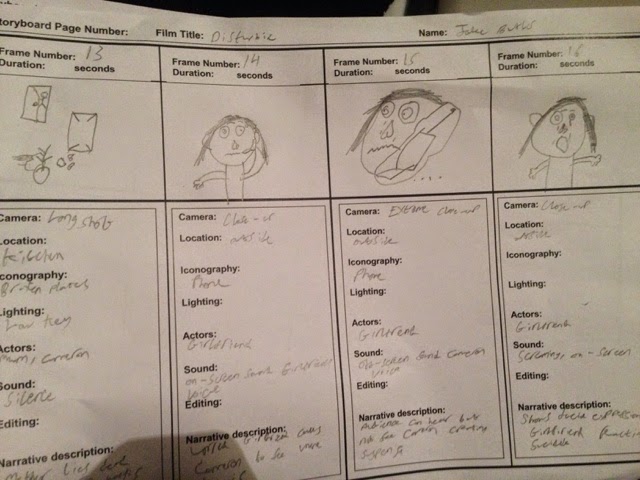
The purpose of a storyboard is to help better plan a scene and to also plan each part of the scene and what happens inside of it. It paints a picture for the scenery in a shot and also the overall imagery. It also allows you to plan the sounds, editing and camera angles of what you plan to film and also the order you plan to film it in.
In our groups, we created individual storyboards to share ideas with eachother about our opening sequence and also show each other what we think the scene should plan out like. It also allows us to compare our ideas and what we think is best for the group as a whole for our production, which is why we are creating a group storyboard afterwards.
My individual post will help will help when we are group planning as it will allow us to compare ideas and use the best possible ideas for our group, which means I could possibly have a better idea than the other two people in my group. I have included the general outline of the plot in my storyboard, but also included the sound and editing featured in each shot and also the narrative of what's happening in the scene, which is vital to planning as our group need to understand what is going on. For example, I included low key lighting in some shots, such as the suicide scene at the beginning to create an enigma and also suspense as the audience are awaiting to see what will happen to the character and fear for him, which is how I made this conventional to a thriller and also set the tone for the audience. I expect the audience to be drawn in to my sequence, as suspense is created by slow timing and also various points of silence throughout some shots, such as the dinner scene to create tension and an eery atmosphere for the audience, making them feel uneasy and on edge and also low key lighting dimming in the mood and the overall plot of the sequence, creating suspense and tension throughout.
I have taken inspirations for my sequence from the Alfred Hitchcock classic, Psycho, which is set in low key lighting but also creates suspense for the audience very well for the audience such as the shower scene, which I incorporate into my beginning shots. In conclusion, I believe my storyboard is well laid out and clearly shows what's needed in each scene such as editing, sound and costumes. From my storyboard, I hope my group incorporate my ideas about sound in the first few shots and also the camera angles during the dinner scene as I believe it is best for the scene and creates suspense and tension for the audience well. Doing this individually and sharing back to our group allows us to compare ideas and also decide what frames and overall storyboard slots are best for the group and our final storyboard.
Tuesday, 18 November 2014
Inspirations-Miss Georgiou
Inspirations
Before we create work, watch a film or even take part in an activity, we need to be inspired inspiration requires interest, but also motivation and we can take inspiration from personal experience and also interest from something we'd seen. If someone had never tried or seen something before and were talked or pressured into something, they would not be inspired and they would need to hear and more importantly see good things from that partially field to be inspired and motivated to take part or do something. For example, with our production, we have taken inspirations from various thriller films and also clips from these films.
Psycho
An Alfred Hitchcock classic was one of our main inspirations for our film for a number of reasons. Mainly for the low key lighting used throughout the film to create suspense and darken the mood, adding tension as the audience do not know what is around the corner. It is essential to use low key lighting in our production, as it is a thriller and is conventional to the genre. The film is also directed very well by hitchcock, who is known very well for building suspense, tension, shock and surprise very well in his films, particularly in this example by using the shower scene to mix all elements into one scene. We use this as an inspiration for our thriller by building suspense throughout, but also shock and surprise when Cameron kills himself and then his mother.


Before we create work, watch a film or even take part in an activity, we need to be inspired inspiration requires interest, but also motivation and we can take inspiration from personal experience and also interest from something we'd seen. If someone had never tried or seen something before and were talked or pressured into something, they would not be inspired and they would need to hear and more importantly see good things from that partially field to be inspired and motivated to take part or do something. For example, with our production, we have taken inspirations from various thriller films and also clips from these films.
Psycho
An Alfred Hitchcock classic was one of our main inspirations for our film for a number of reasons. Mainly for the low key lighting used throughout the film to create suspense and darken the mood, adding tension as the audience do not know what is around the corner. It is essential to use low key lighting in our production, as it is a thriller and is conventional to the genre. The film is also directed very well by hitchcock, who is known very well for building suspense, tension, shock and surprise very well in his films, particularly in this example by using the shower scene to mix all elements into one scene. We use this as an inspiration for our thriller by building suspense throughout, but also shock and surprise when Cameron kills himself and then his mother.
Se7en- From our opening sequence, we took many inspirations from the opening sequence of se7en. It is mainly a dark scene, with low key lighting throughout to dimmen the mood for the audience and also not reveal very much about the plot. The mysterious use of sound throughout also creates suspense and tension for the audience, drawing them into the story, which is vital for us to repeat as we want people to be interested by our sequence and feel emotions towards it.
Human Centipede- Editing is significant in the Human Centipede, elements of slow editing, reaction shots and straight cuts. It is used to slow the action to create suspense for the audience and leave them further waiting to see what will happen next, the reaction shots are used to show facial expressions, allowing the audience to connect with the character and see their emotions. We use this in our sequence for the main character cameron, using reaction shots in his suicide scene or when he kills his mother, which also includes slow editing followed by a straight cut to his frantic girlfriend on the phone.
Overall, our inspirations have inspired us to include key elements at various points of our filming and also gave us ideas on how we could make our production better and more suspenseful.
Monday, 17 November 2014
Planning opening credits
Planning Opening Credits
Opening credits are used at the start of films for a number of reasons. It is mainly used to let the audience know the different roles that will feature in the film and also the film title. Usually the roles should appear on-screen in the order that they do in the film, also having the directors name featured near the very beginning. It lets the audience know who stars in the film. It is essential to make these credits stand out and look interesting to get the audience drawn into the film and also relate it to the genre, e.g you wouldn't have creepy mysterious writing for a comedy film.
https://www.youtube.com/watch?v=OEq-4fua3lM
An example of a well produced starting credits is from the film Se7en. The font and style of credits used is fuzzy scwigly white writing always against a black background. The fuzzy writing could show the mental state of the antagonist being twisted and that he is an evil character and also the colours set the tone of the film with white always being on a black background, showing how a sense of danger may be looming and also the white and black colours could suggest the innocent (white) being killed by the evil (black). This is effective and builds suspense as the audience do not know who may possibly be murdered. The credits of the sequence is a title with the production company name to show the audience who made the film and also to introduce the film showing them the title, followed by the main actors that they will see in the film in order of appearance. Low key lighting is used to show myterious things early on that could really to the film, such as hand prints and a character writing and the audience also feel shocked as there is a part where someone is cutting the skin on their thumb, also creating suspense as the audience want to know why this is happening and also why the previous shots are there too. Tension is built throughout but the upbeat and mysterious music from bass and a piano, keeping the audience on edge and feeling un-easy.
For my credits, I generally want to use a black and white or dark theme to set the tone for the audience and film as our opening sequence is quite dark and covers dark themes such as murder and suicide. The director and main actors names should come up on screen as well as the name of our production to show to the audience. Below are all example of mine and my fellow group members font and colour ideas, the first being mine, second being molly's and third being Claire's. For my design, I chose the colours as white on black, typical for a thriller film and also made the font big, bolg and in capitals to stand out. Although this is effective as it relates to a thriller, it seems a bit basic and also not gripping enough, which is why our group decided not to go with this. Molly's style featured a mix of red, black and white with bold and almost depressing writing. This is clearly conventional to a thriller as dark colours are used and also the use of red could connote blood or danger and it is overall the best presented and looking out of ours so our group decided to go with this. Although Claire's idea is good with the colours and presentation, I do not agree with the font and layout as for me it looks too much like a sci-fi style font, which is why overall it was best to go with Molly's style.
Thoughout our sequence, from the beginning until the point where we show the title of the film font, each person involved in our film will feature in the credits in various different shots. The same font will be used to maintain the atmosphere throughout and gloominess of the film, and our title will be shown behind a black background once all the credits have finished, the white font on black background showing the innocent (white) in danger of the dark and evil (black) , like those around Cameron, his mother and his girlfriend.


Wednesday, 12 November 2014
Planning Characters - Miss Miller
Characters
Cameron - Main Character and Antagonist
Our main character and antagonist, cameron, is an eighteen year old student who lives alone with his mother. His facial expression is always worn out and depressed, showing to the audience that he is in distress, he is also worn out and emotionless due to the amount of time he spends fighting his split personality disorder. In his suicide sequence, he will be wearing white to convey his real innocence and that he is innocent, he cannot help his problems which all could've started at age 10 when his father was murdered, however he wears black in the murder to scene to convey his darkness and he is a sinister character, being conventional to a thriller as this gives an element of surprise to the audience as they believed he was an innocent person, being a paradox to the previous scene and thoughts to they previously thought of Cameron. He has always naturally been a very quiet person
Harmony- Girlfriend
Cameron - Main Character and Antagonist
Our main character and antagonist, cameron, is an eighteen year old student who lives alone with his mother. His facial expression is always worn out and depressed, showing to the audience that he is in distress, he is also worn out and emotionless due to the amount of time he spends fighting his split personality disorder. In his suicide sequence, he will be wearing white to convey his real innocence and that he is innocent, he cannot help his problems which all could've started at age 10 when his father was murdered, however he wears black in the murder to scene to convey his darkness and he is a sinister character, being conventional to a thriller as this gives an element of surprise to the audience as they believed he was an innocent person, being a paradox to the previous scene and thoughts to they previously thought of Cameron. He has always naturally been a very quiet person
Harmony- Girlfriend
Harmony is the worried and paranoid girlfriend of the main character Cameron. She is not a villain and does not assist with helping Cameron kill his own mother, she is a nice character who cares about the mental state of her boyfriend. This allows the audience to symphysis with her as she is a nice character but also because she is clearly in distress which makes the audience feel sorry for her.
Grace- Mother
Our third and final character is Grace, the mother of Cameron. Her husband died when Cameron was 10 and it has been a struggle for her bringing Cameron up, it could be one of the main contributors to Cameron's sadness and depression. She is a nice lady and comes across as a warm and loving mother, and the audience feel sorry for her as not only does she have a lot to deal with, she innocently murdered by her own son after already having a stressful life to deal with.
Monday, 10 November 2014
Planning Sound - Miss Miller
Planning Sound
Parallel
In our production, parallel sound present is of a knife stabbing someone, this shown in the dinner scene where cameron kills his mother. The sound of the knife is used to add emphasis to the pain his mother is feeling and also showing on-screen sound as we see the knife. This leaves the audience being wary and fearful of cameron, leaving them unaware of what he is capable of and always on the alert when he appears in a scene.
Non-Digetic
At the end of our opening sequence piece, we shall play the soundtrack of "tiptoe around the tulips" this is while the credits are being played to play out the scene. This is also a very childlike sounding song, not linking with the violent scene and also the gore in the scene, meaning this also comes as contrapuntal sound. This unsettles the audience and makes them feel uncomfortable, also adding tension to question why the sound is here if it is not related to the scene.
Digetic
During the suicide scene, significant digetic sound occurs such as the chair dragging prior to his suicide, it is an eery sound and creates tension and suspense, the audience are made uncomfortable by the sound and it makes them wary of what may happen next. This prolongs the anticipation of the suicide, it adds another element of mystery as we do not know whether he will kill himself and the audience will find out and shock is created with digetic sound when the chair falls to the ground and the only thing that can be seen are his legs dangling.
Off-Screen
Off-screen sound occurs at various points during our opening sequence, a notable example is when Cameron's girlfriend is on the phone to him and we can hear Cameron's voice but cannot see it, adding a sense of mystery and tension as the audience does not know where the sound is coming from and want to know what Cameron is really up to. This also makes the audience fear for his girlfriend and this adds to the distress of the audience as we see her concerned and almost facial expressions, which are her reactions to what she is hearing but cannot see, just like the audience. This also builds suspense and no one knows where the antagonist is and whether others or himself are in danger.

Parallel
In our production, parallel sound present is of a knife stabbing someone, this shown in the dinner scene where cameron kills his mother. The sound of the knife is used to add emphasis to the pain his mother is feeling and also showing on-screen sound as we see the knife. This leaves the audience being wary and fearful of cameron, leaving them unaware of what he is capable of and always on the alert when he appears in a scene.
Non-Digetic
At the end of our opening sequence piece, we shall play the soundtrack of "tiptoe around the tulips" this is while the credits are being played to play out the scene. This is also a very childlike sounding song, not linking with the violent scene and also the gore in the scene, meaning this also comes as contrapuntal sound. This unsettles the audience and makes them feel uncomfortable, also adding tension to question why the sound is here if it is not related to the scene.
Digetic
During the suicide scene, significant digetic sound occurs such as the chair dragging prior to his suicide, it is an eery sound and creates tension and suspense, the audience are made uncomfortable by the sound and it makes them wary of what may happen next. This prolongs the anticipation of the suicide, it adds another element of mystery as we do not know whether he will kill himself and the audience will find out and shock is created with digetic sound when the chair falls to the ground and the only thing that can be seen are his legs dangling.
Off-Screen
Off-screen sound occurs at various points during our opening sequence, a notable example is when Cameron's girlfriend is on the phone to him and we can hear Cameron's voice but cannot see it, adding a sense of mystery and tension as the audience does not know where the sound is coming from and want to know what Cameron is really up to. This also makes the audience fear for his girlfriend and this adds to the distress of the audience as we see her concerned and almost facial expressions, which are her reactions to what she is hearing but cannot see, just like the audience. This also builds suspense and no one knows where the antagonist is and whether others or himself are in danger.
Planning editing styles - Miss Georgiou
Planning Editing Styles
Reaction Shot
Reaction shots are shots used that are intended to show an characters facial expressions and emotions about an event. In our scene, we shall use this to cut to a phone conversation to show the characters reaction to her boyfriend killing herself. This therefore creates shock which is usually followed by slow editing that emphasises the point. Using a reaction shot in this scene benefits our audience as they cannot see cameron speaking on the phone to his girlfriend, instead it's effective as we see the on-screen characters distress of what she's hearing elsewhere. This type of shot also creates shock and normally follows slow editing, to emphasise the emotions and drag the effect out, further impacting the audience.
Slow Editing
In our production, our suicide scene includes slow editing, to increase the intensity and the drama of what's happening. This is effective and creates suspense as there is a longer wait until the next shot for the audience, keeping them on edge and drawn into the scene, this is conventional to a thriller as this therefore creates suspense. Using this also slows down the timing of the shots.
Filters
Dark filters and low key lighting are used a lot throughout our production. The dark lighting effects are used in our scene to add to the mystery and also keep the overall mood mellow, the colours are not bright and cheerful which also dimmens the mood of the audience and adds tension as they are made to feel uneasy by these colours. This filter is also used typically when showing flashbacks to show it's in the past, as is done in our production when Cameron has a flashback, this builds relationship with the audience as they can relate to what he is feeling and his emotions and the audience also get an insight of the character's past, feeling more connected with him, which can create surprise as the audience may find things they did not know before about the character.

Reaction Shot
Reaction shots are shots used that are intended to show an characters facial expressions and emotions about an event. In our scene, we shall use this to cut to a phone conversation to show the characters reaction to her boyfriend killing herself. This therefore creates shock which is usually followed by slow editing that emphasises the point. Using a reaction shot in this scene benefits our audience as they cannot see cameron speaking on the phone to his girlfriend, instead it's effective as we see the on-screen characters distress of what she's hearing elsewhere. This type of shot also creates shock and normally follows slow editing, to emphasise the emotions and drag the effect out, further impacting the audience.
Slow Editing
In our production, our suicide scene includes slow editing, to increase the intensity and the drama of what's happening. This is effective and creates suspense as there is a longer wait until the next shot for the audience, keeping them on edge and drawn into the scene, this is conventional to a thriller as this therefore creates suspense. Using this also slows down the timing of the shots.
Filters
Dark filters and low key lighting are used a lot throughout our production. The dark lighting effects are used in our scene to add to the mystery and also keep the overall mood mellow, the colours are not bright and cheerful which also dimmens the mood of the audience and adds tension as they are made to feel uneasy by these colours. This filter is also used typically when showing flashbacks to show it's in the past, as is done in our production when Cameron has a flashback, this builds relationship with the audience as they can relate to what he is feeling and his emotions and the audience also get an insight of the character's past, feeling more connected with him, which can create surprise as the audience may find things they did not know before about the character.
Subscribe to:
Posts (Atom)