Friday, 28 November 2014
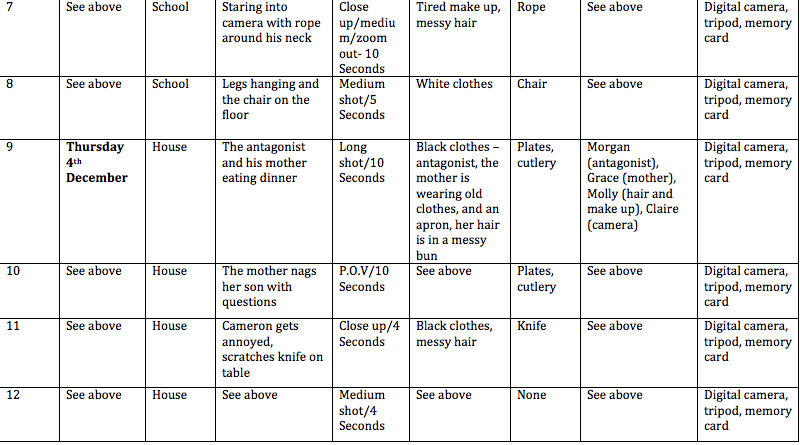
Filming Schedule- Miss Georgiou
A filming schedule is important to have, as it keeps everything organised in your group to do with your filming, such as when and where we will meet too film and also what we will need in each scene. Withput a filming schedule, scene filming would be un-organised and it would be hard to check and remember everything you need, by following the schedule, you know when and where to meet and also what you will need and what shots you will be filming, which is helpful as everything is organised so filming can run smoothly.
Wednesday, 26 November 2014
Group Storyboard- Miss Miller
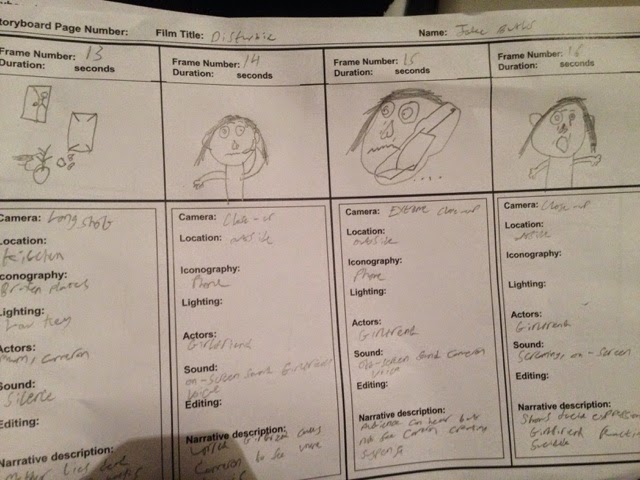
Group Storyboard
It is important to have a group storyboard, because it allows you and your group members to see and know the overall narrative of your scene and also the order you are filming in and your order of shots, which gives you an organised plan and is vital in planning the production. In our group, Me, Molly and Claire all compared eachothers ideas from our own individual storyboards, and decided that Molly's drawings were best, which was why we let her illustrate the storyboard and also Molly took ideas from mine and claire's features of editing and sound such as silence and slow editing to include in our group storyboard.
We included silence in the beginning of the sequence to create tension, the audience are unaware of what's going to happen next and are made uneasy by the silence and also unsettled by the eery squeek of a dragging chair and a closing door. Low key lighting was also important to include, which was featured in all of our individual storyboards as it sets the tone for the audience and is conventional to a thriller as it dimmens the mood, creating tension.
I believe our storyboard is well organised and effective, as we clearly include everything in our narrative and also the key elements in each shot such as sound, editing, characters and lighting. We did well to incorporate all 3 of our ideas into our joint group storyboard, making sure all of our ideas were considered but also making sure we used the most appropriate to the scenes and shots to make the most effective it could possibly be.
It is important to have a group storyboard, because it allows you and your group members to see and know the overall narrative of your scene and also the order you are filming in and your order of shots, which gives you an organised plan and is vital in planning the production. In our group, Me, Molly and Claire all compared eachothers ideas from our own individual storyboards, and decided that Molly's drawings were best, which was why we let her illustrate the storyboard and also Molly took ideas from mine and claire's features of editing and sound such as silence and slow editing to include in our group storyboard.
We included silence in the beginning of the sequence to create tension, the audience are unaware of what's going to happen next and are made uneasy by the silence and also unsettled by the eery squeek of a dragging chair and a closing door. Low key lighting was also important to include, which was featured in all of our individual storyboards as it sets the tone for the audience and is conventional to a thriller as it dimmens the mood, creating tension.
From Molly's storyboard, we also included a lot of the camera angles from the end scene, such as over the shoulder shots and a P.O.V which are conventional to the thriller genre and also allows the audience to connect with the character as the see things from their perspective.
I believe our storyboard is well organised and effective, as we clearly include everything in our narrative and also the key elements in each shot such as sound, editing, characters and lighting. We did well to incorporate all 3 of our ideas into our joint group storyboard, making sure all of our ideas were considered but also making sure we used the most appropriate to the scenes and shots to make the most effective it could possibly be.
Wednesday, 19 November 2014
Individual Storyboard - Miss Miller
Storyboard
The purpose of a storyboard is to help better plan a scene and to also plan each part of the scene and what happens inside of it. It paints a picture for the scenery in a shot and also the overall imagery. It also allows you to plan the sounds, editing and camera angles of what you plan to film and also the order you plan to film it in.
In our groups, we created individual storyboards to share ideas with eachother about our opening sequence and also show each other what we think the scene should plan out like. It also allows us to compare our ideas and what we think is best for the group as a whole for our production, which is why we are creating a group storyboard afterwards.
My individual post will help will help when we are group planning as it will allow us to compare ideas and use the best possible ideas for our group, which means I could possibly have a better idea than the other two people in my group. I have included the general outline of the plot in my storyboard, but also included the sound and editing featured in each shot and also the narrative of what's happening in the scene, which is vital to planning as our group need to understand what is going on. For example, I included low key lighting in some shots, such as the suicide scene at the beginning to create an enigma and also suspense as the audience are awaiting to see what will happen to the character and fear for him, which is how I made this conventional to a thriller and also set the tone for the audience. I expect the audience to be drawn in to my sequence, as suspense is created by slow timing and also various points of silence throughout some shots, such as the dinner scene to create tension and an eery atmosphere for the audience, making them feel uneasy and on edge and also low key lighting dimming in the mood and the overall plot of the sequence, creating suspense and tension throughout.
I have taken inspirations for my sequence from the Alfred Hitchcock classic, Psycho, which is set in low key lighting but also creates suspense for the audience very well for the audience such as the shower scene, which I incorporate into my beginning shots. In conclusion, I believe my storyboard is well laid out and clearly shows what's needed in each scene such as editing, sound and costumes. From my storyboard, I hope my group incorporate my ideas about sound in the first few shots and also the camera angles during the dinner scene as I believe it is best for the scene and creates suspense and tension for the audience well. Doing this individually and sharing back to our group allows us to compare ideas and also decide what frames and overall storyboard slots are best for the group and our final storyboard.
Tuesday, 18 November 2014
Inspirations-Miss Georgiou
Inspirations
Before we create work, watch a film or even take part in an activity, we need to be inspired inspiration requires interest, but also motivation and we can take inspiration from personal experience and also interest from something we'd seen. If someone had never tried or seen something before and were talked or pressured into something, they would not be inspired and they would need to hear and more importantly see good things from that partially field to be inspired and motivated to take part or do something. For example, with our production, we have taken inspirations from various thriller films and also clips from these films.
Psycho
An Alfred Hitchcock classic was one of our main inspirations for our film for a number of reasons. Mainly for the low key lighting used throughout the film to create suspense and darken the mood, adding tension as the audience do not know what is around the corner. It is essential to use low key lighting in our production, as it is a thriller and is conventional to the genre. The film is also directed very well by hitchcock, who is known very well for building suspense, tension, shock and surprise very well in his films, particularly in this example by using the shower scene to mix all elements into one scene. We use this as an inspiration for our thriller by building suspense throughout, but also shock and surprise when Cameron kills himself and then his mother.
Se7en- From our opening sequence, we took many inspirations from the opening sequence of se7en. It is mainly a dark scene, with low key lighting throughout to dimmen the mood for the audience and also not reveal very much about the plot. The mysterious use of sound throughout also creates suspense and tension for the audience, drawing them into the story, which is vital for us to repeat as we want people to be interested by our sequence and feel emotions towards it.
Human Centipede- Editing is significant in the Human Centipede, elements of slow editing, reaction shots and straight cuts. It is used to slow the action to create suspense for the audience and leave them further waiting to see what will happen next, the reaction shots are used to show facial expressions, allowing the audience to connect with the character and see their emotions. We use this in our sequence for the main character cameron, using reaction shots in his suicide scene or when he kills his mother, which also includes slow editing followed by a straight cut to his frantic girlfriend on the phone.
Overall, our inspirations have inspired us to include key elements at various points of our filming and also gave us ideas on how we could make our production better and more suspenseful.
Monday, 17 November 2014
Planning opening credits
Planning Opening Credits
Opening credits are used at the start of films for a number of reasons. It is mainly used to let the audience know the different roles that will feature in the film and also the film title. Usually the roles should appear on-screen in the order that they do in the film, also having the directors name featured near the very beginning. It lets the audience know who stars in the film. It is essential to make these credits stand out and look interesting to get the audience drawn into the film and also relate it to the genre, e.g you wouldn't have creepy mysterious writing for a comedy film.
https://www.youtube.com/watch?v=OEq-4fua3lM
An example of a well produced starting credits is from the film Se7en. The font and style of credits used is fuzzy scwigly white writing always against a black background. The fuzzy writing could show the mental state of the antagonist being twisted and that he is an evil character and also the colours set the tone of the film with white always being on a black background, showing how a sense of danger may be looming and also the white and black colours could suggest the innocent (white) being killed by the evil (black). This is effective and builds suspense as the audience do not know who may possibly be murdered. The credits of the sequence is a title with the production company name to show the audience who made the film and also to introduce the film showing them the title, followed by the main actors that they will see in the film in order of appearance. Low key lighting is used to show myterious things early on that could really to the film, such as hand prints and a character writing and the audience also feel shocked as there is a part where someone is cutting the skin on their thumb, also creating suspense as the audience want to know why this is happening and also why the previous shots are there too. Tension is built throughout but the upbeat and mysterious music from bass and a piano, keeping the audience on edge and feeling un-easy.
For my credits, I generally want to use a black and white or dark theme to set the tone for the audience and film as our opening sequence is quite dark and covers dark themes such as murder and suicide. The director and main actors names should come up on screen as well as the name of our production to show to the audience. Below are all example of mine and my fellow group members font and colour ideas, the first being mine, second being molly's and third being Claire's. For my design, I chose the colours as white on black, typical for a thriller film and also made the font big, bolg and in capitals to stand out. Although this is effective as it relates to a thriller, it seems a bit basic and also not gripping enough, which is why our group decided not to go with this. Molly's style featured a mix of red, black and white with bold and almost depressing writing. This is clearly conventional to a thriller as dark colours are used and also the use of red could connote blood or danger and it is overall the best presented and looking out of ours so our group decided to go with this. Although Claire's idea is good with the colours and presentation, I do not agree with the font and layout as for me it looks too much like a sci-fi style font, which is why overall it was best to go with Molly's style.
Thoughout our sequence, from the beginning until the point where we show the title of the film font, each person involved in our film will feature in the credits in various different shots. The same font will be used to maintain the atmosphere throughout and gloominess of the film, and our title will be shown behind a black background once all the credits have finished, the white font on black background showing the innocent (white) in danger of the dark and evil (black) , like those around Cameron, his mother and his girlfriend.
Wednesday, 12 November 2014
Planning Characters - Miss Miller
Characters
Cameron - Main Character and Antagonist
Our main character and antagonist, cameron, is an eighteen year old student who lives alone with his mother. His facial expression is always worn out and depressed, showing to the audience that he is in distress, he is also worn out and emotionless due to the amount of time he spends fighting his split personality disorder. In his suicide sequence, he will be wearing white to convey his real innocence and that he is innocent, he cannot help his problems which all could've started at age 10 when his father was murdered, however he wears black in the murder to scene to convey his darkness and he is a sinister character, being conventional to a thriller as this gives an element of surprise to the audience as they believed he was an innocent person, being a paradox to the previous scene and thoughts to they previously thought of Cameron. He has always naturally been a very quiet person
Harmony- Girlfriend
Harmony is the worried and paranoid girlfriend of the main character Cameron. She is not a villain and does not assist with helping Cameron kill his own mother, she is a nice character who cares about the mental state of her boyfriend. This allows the audience to symphysis with her as she is a nice character but also because she is clearly in distress which makes the audience feel sorry for her.
Grace- Mother
Our third and final character is Grace, the mother of Cameron. Her husband died when Cameron was 10 and it has been a struggle for her bringing Cameron up, it could be one of the main contributors to Cameron's sadness and depression. She is a nice lady and comes across as a warm and loving mother, and the audience feel sorry for her as not only does she have a lot to deal with, she innocently murdered by her own son after already having a stressful life to deal with.
Monday, 10 November 2014
Planning Sound - Miss Miller
Planning Sound
Parallel
In our production, parallel sound present is of a knife stabbing someone, this shown in the dinner scene where cameron kills his mother. The sound of the knife is used to add emphasis to the pain his mother is feeling and also showing on-screen sound as we see the knife. This leaves the audience being wary and fearful of cameron, leaving them unaware of what he is capable of and always on the alert when he appears in a scene.
Non-Digetic
At the end of our opening sequence piece, we shall play the soundtrack of "tiptoe around the tulips" this is while the credits are being played to play out the scene. This is also a very childlike sounding song, not linking with the violent scene and also the gore in the scene, meaning this also comes as contrapuntal sound. This unsettles the audience and makes them feel uncomfortable, also adding tension to question why the sound is here if it is not related to the scene.
Digetic
During the suicide scene, significant digetic sound occurs such as the chair dragging prior to his suicide, it is an eery sound and creates tension and suspense, the audience are made uncomfortable by the sound and it makes them wary of what may happen next. This prolongs the anticipation of the suicide, it adds another element of mystery as we do not know whether he will kill himself and the audience will find out and shock is created with digetic sound when the chair falls to the ground and the only thing that can be seen are his legs dangling.
Off-Screen
Off-screen sound occurs at various points during our opening sequence, a notable example is when Cameron's girlfriend is on the phone to him and we can hear Cameron's voice but cannot see it, adding a sense of mystery and tension as the audience does not know where the sound is coming from and want to know what Cameron is really up to. This also makes the audience fear for his girlfriend and this adds to the distress of the audience as we see her concerned and almost facial expressions, which are her reactions to what she is hearing but cannot see, just like the audience. This also builds suspense and no one knows where the antagonist is and whether others or himself are in danger.
Subscribe to:
Posts (Atom)